

If your nails have been feeling fragile lately, you’ve probably wondered: are dip nails better than gel for weak nails or is it the other way around?
It’s one of the most common questions we hear at the salon. And the honest answer is: it depends on your nails, not just the trend. Both options have real benefits and both can cause damage if the technique or timing isn’t right.
Let’s break it all down so you can walk into your next appointment feeling confident about your choice.
Quick Answer: Dip vs Gel for Weak Nails
Here’s the short version for those who need it fast:
- Dip nails offer more rigidity and structure – great for nails that bend, snap, or break easily
- Gel nails are lighter and more flexible – better suited for thin, recovering, or naturally soft nails
- The best choice depends on your nail condition, not just what’s trending or what your friend is getting
Still not sure which is right for you? Keep reading – we’ll walk you through every detail.
What Do “Weak Nails” Actually Mean?
Before choosing a service, it helps to understand what kind of weakness you’re dealing with. Not all weak nails are the same.
Thin vs Brittle vs Peeling Nails
- Thin nails – naturally fine, bend easily, feel almost translucent
- Brittle nails – snap or break suddenly, often at the tip or sides
- Peeling nails – the nail plate separates in layers, often from dryness or over-filing
Each responds differently to the product – which is exactly why a one-size-fits-all answer doesn’t work.
Common Causes of Weak Nails
Nails don’t weaken overnight. Usually there’s a pattern:
- Over-filing or buffing during prep
- Improper or forceful product removal (especially peeling gel!)
- Too many back-to-back appointments without recovery time
- Lifestyle factors: dehydration, nutrition gaps, frequent hand washing
Signs Your Nails May Already Be Damaged
Watch for these before your next booking:
- Nails that split vertically or horizontally
- Layers peeling away from the surface
- Sensitivity when tapping or pressing nails
If any of these sound familiar, your nail care approach – not just the product – needs to change.
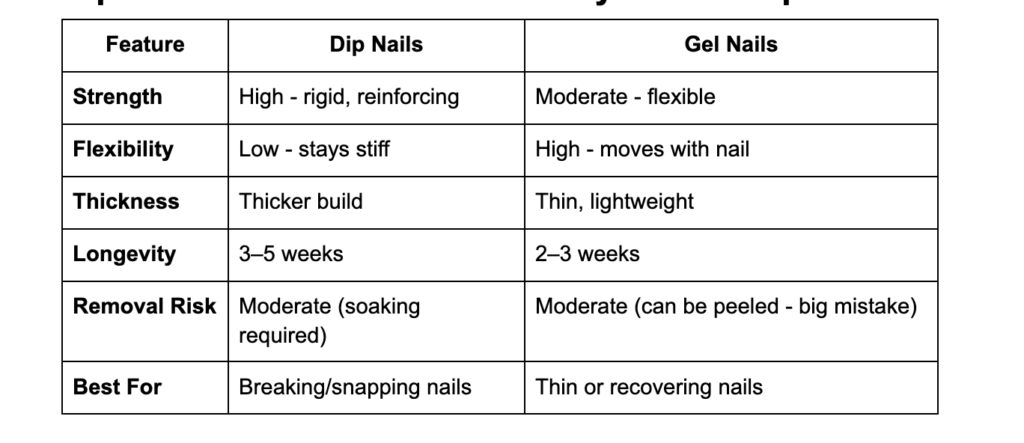
Dip vs Gel for Weak Nails: Side-by-Side Comparison
Are Dip Nails Better for Weak Nails?
When Dip Nails Are a Better Choice
Dip powder creates a hard, durable layer over the nail – like a protective shell. This makes it the better pick when:
- Your nails break easily and need structural support
- You want longer wear without frequent touch-ups
- You work with your hands a lot and need something that holds up
The powder-and-sealant system in dip also tends to be thinner than acrylic while still providing rigidity – a nice balance for nails that need strength without heaviness.
When Dip Nails May NOT Be Ideal
More structure isn’t always better. Dip can actually work against you if:
- Your nails are very thin or have been over-filed – the weight can stress the nail plate
- You have peeling nails – product can get under the layers and worsen separation
- Your nail beds are sensitive – the rigidity leaves no room for natural flex
In these cases, something lighter and more forgiving may serve your nails better.
Are Gel Nails Better for Weak Nails?
When Gel Nails Are a Better Choice
A properly applied gel manicure is one of the most nail-friendly options available — when done correctly. Gel is the smarter choice when:
- Your nails are naturally thin and flexible
- You’re in a recovery phase after damage or over-processing
- You prefer a lighter, more natural-looking finish
Builder gel in particular – thicker than regular gel polish – can add a gentle layer of protection without the full rigidity of dip, making it a popular recommendation for thin nails that need a little support without restriction.
When Gel May Not Be Enough
On the flip side, if your nails snap easily and you need real structural reinforcement, a standard gel polish may not provide enough protection. Nails that break at the free edge mid-cycle need something more substantial than polish – even gel polish.
How to Protect Weak Nails (No Matter Which You Choose)
The product matters – but the technique and aftercare matter just as much.
Choose Gentle Prep Techniques
Over-filing is one of the leading causes of nail damage in salons. A light buff for adhesion is all that’s needed. Aggressive prep thins the nail plate significantly over time.
Never Peel Product Off
We cannot say this enough: peeling gel or dip off removes the top layer of your nail with it. Always soak off properly – it takes a little longer, but the difference in nail health is dramatic.
Use Cuticle Oil Daily
Cuticle oil isn’t just for cuticles. It conditions the entire nail plate, improving flexibility and reducing brittleness. Apply it every night – or more often if your hands are in water frequently.
Keep Nails Shorter While Recovering
Longer nails on a weak nail plate = more leverage, more breakage. Keeping length modest while nails recover gives the new growth a chance to come in strong.
Space Out Appointments If Needed
If your nails are consistently fragile, consider taking a break between services – or switching to a nail strengthener treatment for a cycle or two.
When You Should Avoid Both Dip and Gel
Sometimes the most caring thing to do is pause. Skip both dip and gel if you’re experiencing:
- Severe peeling – product won’t adhere properly and may cause further separation
- Pain or inflammation around the nail bed
- Signs of infection – discoloration, swelling, unusual odor
In these cases, letting your nails rest and recover first will always lead to better long-term results than pushing through.
Pro Salon Tips Before Booking Your Next Manicure
What to Tell Your Nail Technician
Before your appointment, mention:
- How your nails have been feeling (weak, peeling, breaking)
- What service you had last time and how removal went
- Any sensitivity or changes you’ve noticed
This gives your nail tech the context needed to make the right recommendation – instead of guessing.
Questions to Ask Before Choosing a Service
- “Given what my nails look like right now, what would you recommend?”
- “How do you remove this product at the end of the wear cycle?”
- “Is there a builder or strengthening option that might work better for me?”
Why Customization Matters More Than Trends
What works beautifully on your friend’s thick, healthy nails might not be the right call for yours. A skilled nail technician will always assess before they apply – not the other way around.
Find Your Perfect Manicure at Our Nails Salon in Corona, CA
Not sure whether dip or gel is the right fit for your nails right now? That’s exactly what we’re here for.
At Double OO Nails & Spa, our experienced nail technicians take the time to assess your nail condition before recommending any service. Whether you’re dealing with brittle, thin, or recovering nails – we’ll help you find the option that protects what you have while giving you the beautiful results you deserve.
Because healthy nails and gorgeous nails? They go together perfectly.
📍 Double OO Nails & Spa – Corona, CA. Book your appointment today and let’s find the manicure that loves your nails back.
FAQs
Are dip nails less damaging than gel?
Neither is inherently more damaging than the other – it comes down to prep, application, and removal technique. Both can be very nail-friendly or quite damaging depending on how they’re done.
Is gel better for thin nails?
In many cases, yes. The flexibility of gel is gentler on thin nail plates than the rigidity of dip. Builder gel in particular can add protective structure without over-stressing thin nails.
Which lasts longer on weak nails?
Dip typically lasts longer (3–5 weeks vs. 2–3 weeks for gel). But longevity only matters if the nail underneath stays healthy during that time.
Can weak nails recover under dip or gel?
Yes – with proper technique, adequate prep, and good aftercare. The new nail growth coming in underneath can improve significantly if the overlay isn’t damaging the nail plate.
What is the safest manicure for damaged nails?
A gentle gel manicure or builder gel with minimal prep, proper soak-off removal, and daily cuticle oil care is generally the most nail-friendly approach for recovering nails.
